Aims and Scope
Aims
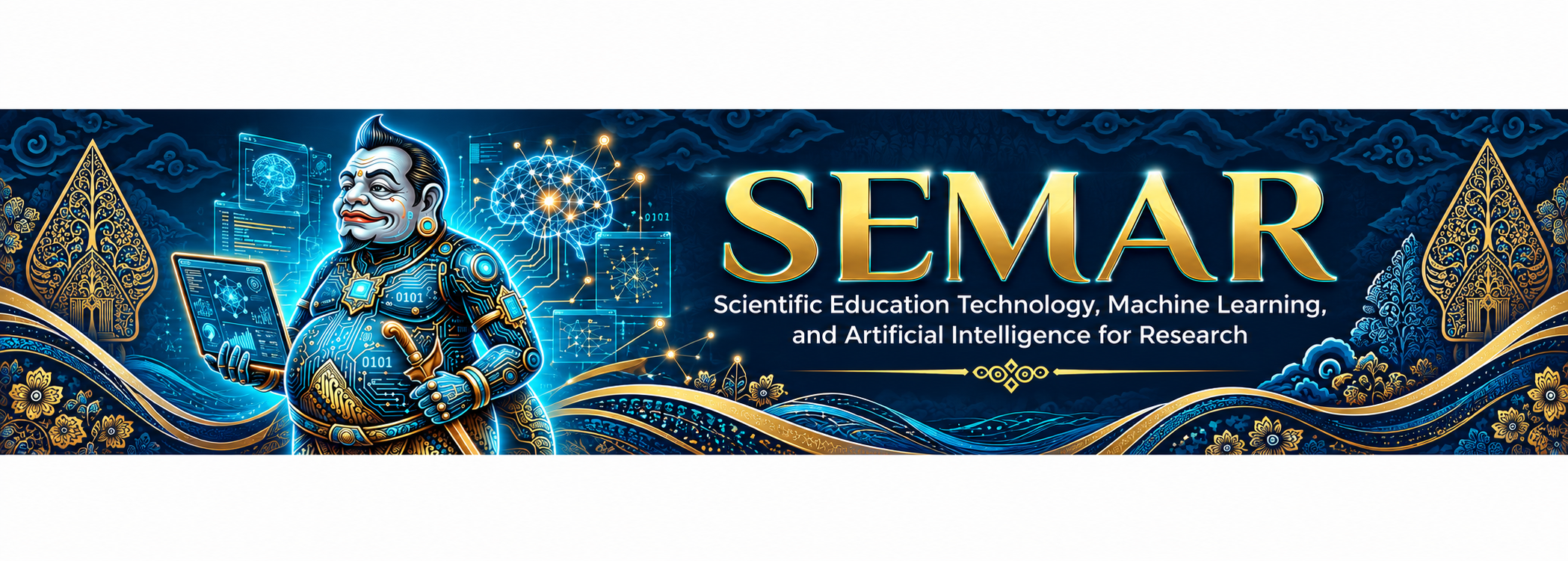
Semar Journal (Scientific Education in Machine Learning and Artificial Intelligence for Research) is an international, peer-reviewed, open-access scholarly journal dedicated to advancing scientific knowledge and promoting innovation in artificial intelligence, machine learning, education, and educational technology.
The journal aims to provide an interdisciplinary platform for researchers, academics, educators, and practitioners to disseminate original research, theoretical contributions, methodological developments, and practical applications that advance the understanding and responsible implementation of intelligent technologies. Semar Journal particularly encourages research that bridges computational innovation with educational transformation, scientific discovery, and real-world problem-solving.
The journal seeks to foster collaboration across computer science, data science, education, and related disciplines by promoting rigorous, reproducible, ethical, and impactful research. It also aims to contribute to the development of intelligent systems, technology-enhanced learning environments, and data-driven approaches that support innovation in research, education, and society.
Scope
Semar Journal welcomes original research articles, review papers, and other scholarly contributions that align with its interdisciplinary focus. The journal's scope includes, but is not limited to, the following areas:
-
Artificial Intelligence: AI methodologies, intelligent systems, generative AI, autonomous systems, knowledge representation, reasoning, and AI-based decision support.
-
Machine Learning: Supervised and unsupervised learning, reinforcement learning, semi-supervised learning, optimization techniques, predictive modeling, and advanced learning algorithms.
-
Deep Learning: Deep neural networks, transformer architectures, representation learning, transfer learning, and deep learning applications across scientific and educational domains.
-
Natural Language Processing: Text mining, sentiment analysis, language models, information extraction, speech processing, and multilingual language technologies.
-
Computer Vision and Image Processing: Image classification, object detection, image segmentation, visual recognition, and intelligent image analysis.
-
AI in Education: AI-supported teaching and learning, personalized learning, intelligent tutoring systems, automated assessment, adaptive instruction, and AI-assisted educational decision-making.
-
Educational Technology: Learning management systems, digital learning platforms, educational software, technology-enhanced learning, immersive learning environments, educational applications, and emerging technologies for teaching and learning.
-
Learning Analytics and Educational Data Mining: Student performance prediction, learning behavior analysis, academic risk identification, educational data visualization, and data-driven educational improvement.
-
Data Science and Knowledge Discovery: Big data analytics, data mining, pattern recognition, statistical learning, knowledge discovery, and data-driven approaches to scientific and organizational challenges.
-
Explainable, Trustworthy, and Responsible AI: Explainable AI, model interpretability, algorithmic fairness, transparency, privacy, security, accountability, and human-centered AI.
-
AI for Scientific Research: AI-assisted scientific discovery, computational research methods, automated data analysis, research automation, knowledge synthesis, and intelligent tools for scientific investigation.
-
Emerging Technologies and Digital Innovation: Integration of AI and machine learning with cloud computing, the Internet of Things, extended reality, and other emerging technologies for educational, scientific, and societal applications.
-
Ethical, Social, and Policy Dimensions of AI: AI governance, digital ethics, algorithmic bias, responsible technology adoption, data protection, and the social implications of intelligent technologies.
The journal prioritizes submissions that demonstrate methodological rigor, clear research contributions, appropriate evaluation, and relevance to the advancement of knowledge. Interdisciplinary studies are particularly encouraged when they establish meaningful connections between AI, machine learning, education, educational technology, and scientific research.
Semar Journal welcomes contributions from researchers and practitioners worldwide and seeks to promote responsible technological innovation, international scholarly collaboration, and the advancement of science and education.