
Peer Review Process
1. Peer Review Policy
Semar Journal is committed to maintaining high standards of academic quality, research integrity, and publication ethics. All research manuscripts submitted to the journal undergo an editorial assessment and, if deemed suitable, a rigorous peer-review process to evaluate their originality, scientific quality, methodological rigor, relevance, and contribution to the advancement of knowledge.
The journal applies a double-anonymous peer review process, in which the identities of authors and reviewers are concealed from each other throughout the review process. This policy is intended to promote objective, independent, and impartial evaluation of submitted manuscripts.
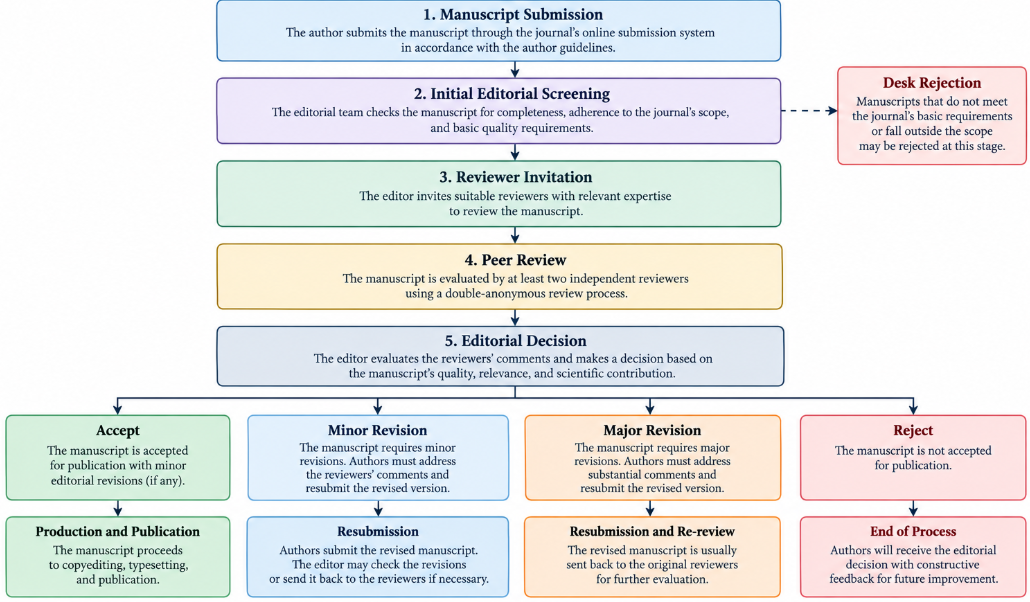
2. Initial Editorial Screening
Upon submission, each manuscript is examined by the editorial team to determine its suitability for further consideration. The initial screening includes the following aspects:
-
Alignment with the aims and scope of Semar Journal.
-
Compliance with the journal's author guidelines and manuscript format.
-
Originality and preliminary assessment of potential plagiarism or redundant publication.
-
Clarity of the research objectives, problem formulation, and scientific contribution.
-
Adequacy of the research methodology and presentation of results.
-
Compliance with applicable research ethics requirements.
Manuscripts that do not meet the journal's basic requirements may be returned to the authors for technical correction or rejected without external review. Passing the initial screening does not guarantee acceptance for publication.
3. Assignment of Reviewers
Manuscripts that pass the initial screening are assigned to at least two independent reviewers with relevant expertise in the subject area of the submission. Reviewers are selected based on their academic qualifications, research experience, subject-matter expertise, and ability to provide an objective and constructive assessment.
Reviewers must disclose any potential conflicts of interest and decline assignments when they cannot provide an impartial evaluation. The journal seeks to ensure that reviewers are independent of the authors and their institutions and have no relationships that could compromise the integrity of the review process.
4. Review Criteria
Reviewers are requested to evaluate manuscripts based on the following criteria:
-
Originality and Novelty: The extent to which the manuscript presents original ideas, findings, methods, or applications.
-
Relevance and Scope: The alignment of the manuscript with the aims and scope of Semar Journal.
-
Literature Review: The adequacy, relevance, and critical analysis of the cited literature.
-
Methodological Rigor: The appropriateness, transparency, and reproducibility of the research design, methods, experiments, and analytical procedures.
-
Results and Discussion: The validity of the findings, quality of the analysis, and strength of the interpretation in relation to the research objectives and existing literature.
-
Scientific and Practical Contribution: The significance of the findings for artificial intelligence, machine learning, education, educational technology, or related research domains.
-
Ethical Compliance: Appropriate treatment of research ethics, data privacy, informed consent where applicable, responsible AI practices, and other relevant ethical considerations.
-
Clarity and Presentation: The organization, academic language, quality of figures and tables, and overall readability of the manuscript.
For computational and AI-related studies, reviewers may also assess the suitability of datasets, experimental design, baseline comparisons, evaluation metrics, reproducibility, and the transparency of model development and validation.
5. Review Recommendations and Editorial Decisions
After completing their assessments, reviewers submit written comments and recommendations to the editor. The final decision is made by the editor based on the reviewers' reports, the manuscript's scientific merit, and the journal's editorial policies.
The possible editorial decisions are:
-
Accept: The manuscript is accepted for publication without further substantive revision, subject to any necessary editorial or production adjustments.
-
Minor Revision: The manuscript requires limited revisions that do not substantially alter the core research contribution.
-
Major Revision: The manuscript requires substantial improvements in its methodology, analysis, interpretation, presentation, or other important aspects before it can be reconsidered.
-
Reject: The manuscript does not meet the journal's standards for scientific quality, originality, relevance, methodological rigor, or ethical compliance.
A revision request does not guarantee acceptance. Revised manuscripts may be returned to the original reviewers for further evaluation, depending on the nature and extent of the requested changes.
6. Revision and Resubmission
Authors receiving a revision decision are expected to address the reviewers' comments carefully and submit a revised manuscript within the deadline specified by the edit